
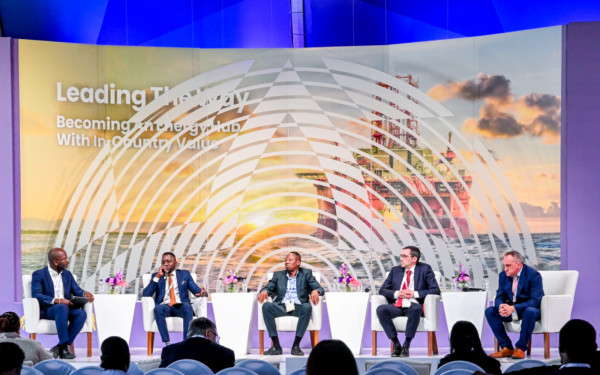
The National Petroleum Corporation of Namibia (NAMCOR) has revealed that the country could produce more than 2.5 million tons of natural gas per year, based on early-stage assessments of recent discoveries made since 2022.
Speaking during a panel discussion on gas monetization strategies at the Namibia International Energy Conference on April 24, Mtundeni Ndafyaalako, Executive of Upstream Development & Production at national oil company NAMCOR, outlined a dual-pronged approach adopted by the corporation.
The first pillar focuses on leveraging legislative frameworks to enable coordinated infrastructure development, fostering collaboration among operators. The second emphasizes expanding exploration activities to unlock further resources.
“We have launched a gas monetization strategy project to support both government and industry on how best to commercialize gas. From our appraisals, we now have a clearer picture of production potential and various applications,” said Ndafyaalako, noting that the strategy is designed to attract new players and investment by clarifying monetization pathways.
Manfriedt Muundjua, Deputy General Manager at BW Kudu, reinforced the importance of integrating four pillars of local content – training, skills transfer, local procurement and local ownership – into the broader gas development framework.
Muundjua shared that BW Kudu is placing Namibian interns in every technical role currently held by international staff, supporting long-term local capacity building. He also emphasized the urgent need for downstream investment and infrastructure development.
“We already have a downstream investment partner lined up to join us once production at Kudu begins,” he said.He added that drilling of additional wells is scheduled to begin in October, supporting NAMCOR’s emphasis on continued exploration to identify new reserves.
Paul Eardley-Taylor, Head of Oil & Gas Coverage for Southern Africa at Standard Bank, highlighted the need for a “shadow infrastructure” – potentially led by public-private partnerships – in southern Namibia to address energy shortages through gas utilization. He suggested that oil revenues should be strategically directed toward financing gas infrastructure and fostering local energy markets.
Eardley-Taylor also pointed to the broader regional opportunity, suggesting that Namibia could assume a role once held by South Africa as the region’s primary energy supplier, particularly as critical mineral projects are willing to pay a premium for stable power supply.
Meanwhile, Ian Thom, Research Director for Upstream at Wood Mackenzie, expressed confidence that Namibia could implement a comprehensive Gas Master Plan within the next nine months. With only 59% of the population currently connected to the electricity grid, Thom underscored the potential of gas to dramatically increase energy access across residential, commercial and industrial sectors.
“Namibia could generate more value by exporting electricity rather than raw gas, given the limited infrastructure for gas exports and the high costs associated with building it,” Thom said.
Looking ahead, the upcoming African Energy Week (AEW): Invest in African Energies conference – set to take place from September 29 to October 3, 2025, in Cape Town – will spotlight Namibia’s gas developments and broader African opportunities The event will feature panel discussions, project showcases, deal signings and high-level networking sessions that connect African energy projects with global investors.
AEW: Invest in African Energies is the platform of choice for project operators, financiers, technology providers and government, and has emerged as the official place to sign deals in African energy. Visit www.AECWeek.com for more information about this exciting event.
Distributed by APO Group on behalf of African Energy Chamber.
The National Petroleum Corporation of Namibia (NAMCOR) has revealed that the country could produce more than 2.5 million tons of natural gas per year, based on early-stage assessments of recent discoveries made since 2022.
Speaking during a panel discussion on gas monetization strategies at the Namibia International Energy Conference on April 24, Mtundeni Ndafyaalako, Executive of Upstream Development & Production at national oil company NAMCOR, outlined a dual-pronged approach adopted by the corporation.
The first pillar focuses on leveraging legislative frameworks to enable coordinated infrastructure development, fostering collaboration among operators. The second emphasizes expanding exploration activities to unlock further resources.
“We have launched a gas monetization strategy project to support both government and industry on how best to commercialize gas. From our appraisals, we now have a clearer picture of production potential and various applications,” said Ndafyaalako, noting that the strategy is designed to attract new players and investment by clarifying monetization pathways.
Manfriedt Muundjua, Deputy General Manager at BW Kudu, reinforced the importance of integrating four pillars of local content – training, skills transfer, local procurement and local ownership – into the broader gas development framework.
Muundjua shared that BW Kudu is placing Namibian interns in every technical role currently held by international staff, supporting long-term local capacity building. He also emphasized the urgent need for downstream investment and infrastructure development.
“We already have a downstream investment partner lined up to join us once production at Kudu begins,” he said.He added that drilling of additional wells is scheduled to begin in October, supporting NAMCOR’s emphasis on continued exploration to identify new reserves.
Paul Eardley-Taylor, Head of Oil & Gas Coverage for Southern Africa at Standard Bank, highlighted the need for a “shadow infrastructure” – potentially led by public-private partnerships – in southern Namibia to address energy shortages through gas utilization. He suggested that oil revenues should be strategically directed toward financing gas infrastructure and fostering local energy markets.
Eardley-Taylor also pointed to the broader regional opportunity, suggesting that Namibia could assume a role once held by South Africa as the region’s primary energy supplier, particularly as critical mineral projects are willing to pay a premium for stable power supply.
Meanwhile, Ian Thom, Research Director for Upstream at Wood Mackenzie, expressed confidence that Namibia could implement a comprehensive Gas Master Plan within the next nine months. With only 59% of the population currently connected to the electricity grid, Thom underscored the potential of gas to dramatically increase energy access across residential, commercial and industrial sectors.
“Namibia could generate more value by exporting electricity rather than raw gas, given the limited infrastructure for gas exports and the high costs associated with building it,” Thom said.
Looking ahead, the upcoming African Energy Week (AEW): Invest in African Energies conference – set to take place from September 29 to October 3, 2025, in Cape Town – will spotlight Namibia’s gas developments and broader African opportunities The event will feature panel discussions, project showcases, deal signings and high-level networking sessions that connect African energy projects with global investors.
AEW: Invest in African Energies is the platform of choice for project operators, financiers, technology providers and government, and has emerged as the official place to sign deals in African energy. Visit www.AECWeek.com for more information about this exciting event.
Africa Fact: In around 300 BC, the Sudanese invented a writing script that had twenty-three letters of which four were vowels and there was also a word divider. Hundreds of ancient texts have survived that were in this script. Some are on display in the British Museum.
Source: MyZA.co.za which offers: Free Advert/Marketplace Submissions | Free Directory Listings | Free News Submission | Free Event Submissions


 A Modern Rehab Alternative: At-Home Addiction Recovery Service Offering Full Medical Detox