
When over one million applicants queue for tickets to a major event hosted in South Africa, it isn’t just a testament to the country’s world-class entertainment and hosting capabilities—it represents a monumental economic windfall for the local tourism sector.
See: https://myza.co.za/over-1-million-apply-for-tickets-to-sa-event/
Tourism has long been one of South Africa’s key economic engines, directly creating jobs, fuelling small business development, and injecting millions in foreign currency directly into local communities. Mass-scale events act as global magnets, converting interest into direct foreign travel and economic momentum.
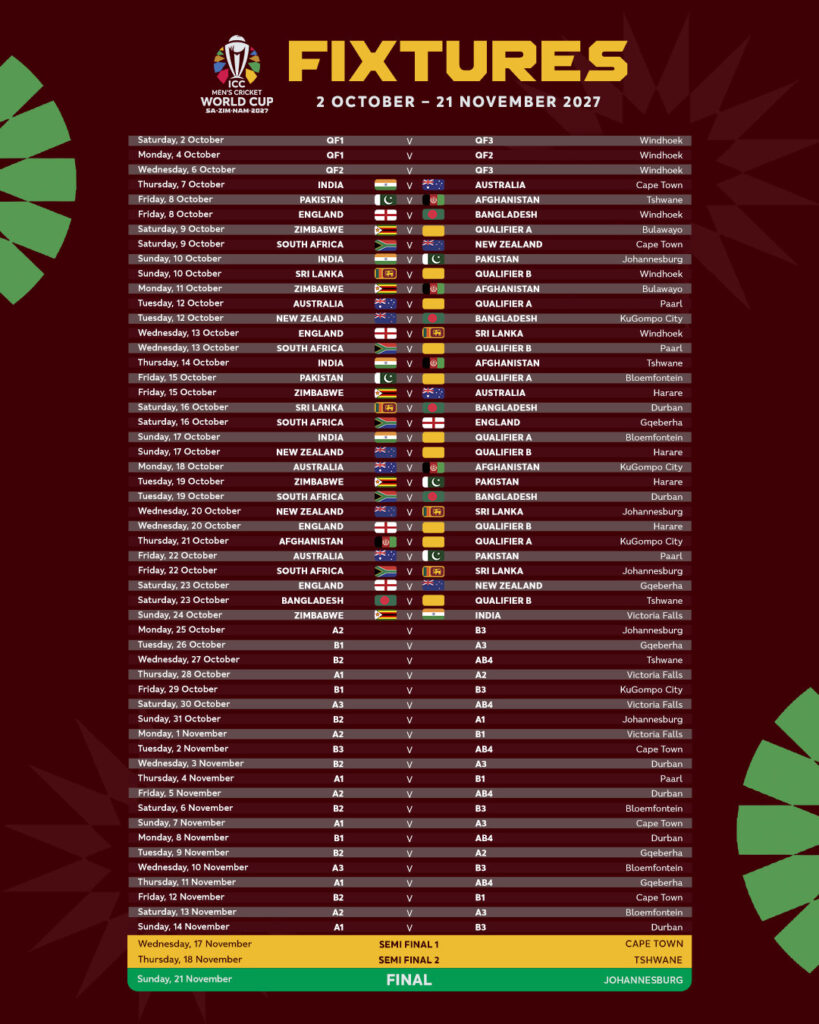
The 2027 ICC Cricket World Cup matches in South Africa will be played in these cities: Cape Town, Paarl, Johannesburg, Tshwane, Bloemfontein, Durban, Gqeberha and KuGompo City.
The Power of the Foreign Tourist Dollar: A Look at Bed-Night Value
The financial impact of a international visitor extends far beyond the ticket price at the gate. According to travel economy data and South African Tourism performance benchmarks, a mid-range foreign tourist injects between $130 and $290 USD (approx. R2,300 to R5,200 ZAR) per bed-night into the local economy. High-end and luxury international travellers spend upwards of $390+ USD (R7,000+ ZAR) per night when including boutique accommodation, high-end dining, and private transfers.
To put the value of foreign tourist bed-nights into perspective:
| Visitor Category | Estimated Daily Spend per Bed-Night (USD) | Estimated Daily Spend per Bed-Night (ZAR)* |
| Budget Foreign Tourist | ~$67 per night | ~R1,200 |
| Mid-Range Foreign Tourist | ~$167 to $290 per night | ~R3,000 – R5,200 |
| Luxury / Premium Tourist | ~$390+ per night | ~R7,000+ |
*Converted at standard exchange rates.
Where That Money Goes
When an overseas traveller spends a night in South Africa, their daily expenditure cascades through the local ecosystem:
- Accommodation (40–45%): Hotels, guesthouses, lodges, and local B&Bs.
-
Food & Dining (20–25%): Local restaurants, cafes, and markets.
- Transport (10–15%): Uber drivers, car rentals, domestic flights, and private shuttles.
- Activities & Retail (15–20%): Local excursions, tours, craft markets, and retail shopping.
A Cumulative Ripple Effect
If even a fraction of those 1 million ticket applicants represents international visitors booking multi-day stays (the average international stay ranges from 7 to 10 nights), the cumulative financial impact quickly reaches hundreds of millions—if not billions—of Rands.
Events of this scale don’t just fill venue seats; they fill hotel beds, restaurant tables, taxi rides, and tour bookings. Furthermore, high-visibility global events offer long-term marketing value: visitors who come for an event often return as leisure tourists or encourage friends and family to visit later.
South Africa possesses world-class infrastructure, breath taking scenery, and unmatched hospitality. Welcoming global events of this magnitude is one of the fastest, most effective ways to drive sustainable economic growth, sustain local jobs, and showcase the best of Mzansi to the world.
Images:
CLICK HERE to submit your press release to MyPR.co.za.
Read More: A Multi-Billion Rand Opportunity: Why High-Impact Events Are the Catalyst South Africa’s Economy Needs.
The Release of Nelson Mandela (1990): On February 11, 1990, the world’s media descended on Cape Town as Nelson Mandela stepped out of Victor Verster Prison a free man after 27 years. Hours later, he addressed a massive, surging crowd of over 100,000 people from the balcony of Cape Town City Hall. His speech—broadcast live to hundreds of millions worldwide—marked the official death knell of apartheid and established Cape Town as the global stage for South Africa’s democratic dawn.


 Atlantis 4×4 Fun Day