
A Cape Town Castle Military Museum tagged image from photographer – Jorge Lascar as published on Flickr.
Belgrade Fortress
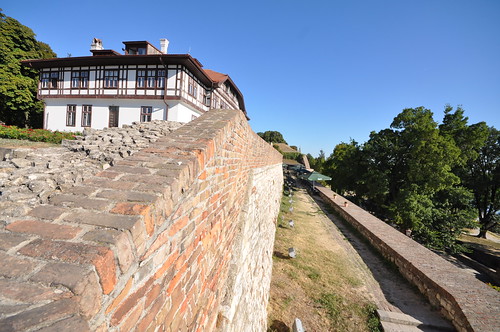
Image by Jorge Lascar
The Belgrade Fortress was built as a defensive structure on a ridge overlooking the confluence of the Sava and the Danube rivers during the period from the 2nd to the 18th century. Today the fortress is a unique museum of the history of Belgrade. The complex is made up of the Belgrade Fortress itself, divided into the Upper and Lower Town (Gornji/Donji Grad), and the Kalemegdan Park.
Because of its exceptional strategic importance, a fortification — a Roman castrum — was erected here in the 2nd century AD, as a permanent military camp for the Fourth Flavian Legion. After being razed to the ground by the Goths and the Huns, the fortification was rebuilt in the first decades of the 6th century. Less than a century later it was demolished by the Avars and the Slavs.
Around this fortification on the hill above the Sava and Danube confluence, the ancient settlement of Singidunum grew up, later to become the Slav settlement of Belgrade. The Belgrade Fortress has been demolished and rebuilt on numerous occasions. On top of the Roman walls stand Serbian ramparts and on top of them, Turkish and Austrian fortifications. In the 12th century the Byzantine Emperor Manuel I Comnenus built a new castle on the Roman ruins. During the first decades of the 14th century this small hill-top fortification was extended as far as the river banks.
Under the rule of Despot Stefan Lazarević, Belgrade became the new capital of Serbia and was reinforced by the addition of extensive fortifications to the Upper and Lower Town. The Despot’s palace was built in the old castle, and a military harbour was added on the Sava river. An advanced mediaeval city developed within the ramparts.
A new era began with the Austro-Turkish War. As a key fortification at the heart of the armed conflicts of the 18th century, the Fortress was rebuilt three times. Under the Austrian occupation from 1717 to 1739, and after the construction of new modern fortifications, the Belgrade Fortress was one of the most powerful military strongholds in Europe. It was built according to plans drawn up by Colonel Nicolas Doxat de Démoret, a Swiss serving in the Austrian army. Before the Turks returned to Belgrade in 1740 all the newly constructed fortifications were demolished. By the end of the 18th century the Belgrade fortress had taken on its final form.
KALEMEGDAN
Kalemegdan, today Belgrade’s most beautiful and largest park, was during the time that the Fortress was Belgrade’s main military stronghold, used to observe and await the enemy in battle.
Consequently its name derives from the Turkish words kale meaning ‘fort’ and meydan meaning ‘square’ or ‘field’. The Turks also called Kalemegdan Fikir -bayır which means ‘hill for contemplation’.
Kalemegdan contains the Keys of the Belgrade Fortress memorial, the Monument of Gratitude to France, the Cvijeta Zuzorić Art Pavilion, the Music Pavilion, the Great Steps (Veliko Stepenište), the Zoo, a children’s fun fair, and a number of monuments, sculptures, sports facilities, resturants and cafés.
Belgrade Fortress today is a cultural property of great importance, and a venue for frequent cultural, artistic and entertainment events [Serbia.travel]

CLICK HERE to submit your Cape Town news.
This image – – was automatically curated and published using the WP Robot plugin – CLICK HERE to try WP Robot for WordPress – a massive time saver.


 Cape Town Image: 1920 Parish of Bethnal Green 1848