
A Cape Town Castle Military Museum tagged image from photographer – Gord McKenna as published on Flickr.
Douglas C-47A Skytrain 2011
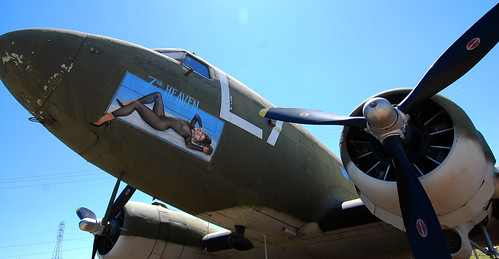
Image by Gord McKenna
Castle Air Force Base, near Merced, California. What a great place to visit.
"When the closure of Castle Air Force Base was announced in 1994, a group of dedicated enthusiasts in the Atwater-Merced area formed a non-profit organization called the Castle Air Museum Foundation, Inc. Their purpose was to assume custody of the collection of aircraft. It was their dream to build a museum in which faithfully restored historic aircraft could be exhibited for public enjoyment.
Castle Air Museum represents history in a way the whole family can share with our awe-inspiring majestic warbirds. To stand under the wing of the Convair RB-36H Peacemaker or the Boeing B-52, you can imagine the sky around the bombers filled with enemy fighters."
The Skytrain, Dakota (Great Britan, Canada and Commonwealth countries), and the Gooney Bird. This aircraft has many names and the well-deserved reputation of being one of the greatest airplanes ever built. The C-47 is the military version of the famed DC-3 airliner, which revolutionized the civilian aviation industry. Likewise, its military sister, the C-47, has had a similar distinguished career. Combined production of the DC-3, DST and C-47 plus other variants totaled 10,654. The last C-47 left Air Force service in 1975.
Pressed into service in World War II, it became the major transport for the allies. It also carried cargo, dropped paratroops and served as a glider tow vehicle in support of major airborne operations such as D-Day and Operation Market Garden. Many of them served with the RAF as Dakotas.
C-47s played a major role in the Berlin Airlift and in Korea. Others were sold to the civilian market and, from these aircraft, many an airline was born. The C-47 saw service well into the Vietnam Conflict era. A gunship version , code named "Puff the Magic Dragon", supported ground troops until being replaced by AC-130 Spectre gun ships.
Every branch of the U.S military and all the major allied powers flew it. The U.S. Navy version was the R4D. The British, Canadians and the Australians designated it the Dakota (a clever acronym composed of the letters DACoTA for Douglas Aircraft Company Transport Aircraft). The aircraft operated from every continent in the world and participated in every major battle. By the end of World War II, more than 10,000 had been built. For all of its official and unofficial names, it came to be known universally as the "Gooney Bird." General Dwight D. Eisenhower, Supreme Commander of Allied Forces in Europe, termed it one of the most vital pieces of military equipment used in winning the war.
The longest serving Aircraft in the RCAF/CF, the "Dak" entered service in 1943 and some continued to fly until January, 1990. In June, 1970 the Dakotas were redesignated as CC-129 and the remaining fleet of 71 was reserialled causing the Aircraft originally delivered as 42-23971, known to the RCAF as 659 suddenly became 12940 (or just 940). The Dakota has served the Canadian Air Force from the Second World War until its retirement in 1989. In Canadian service, the "Dak" was used for transportation of troops and supplies, navigation training, search-and-rescue and training CF-104 pilots to use the CF-104’s radar.
The aircraft on display at Castle Air Museum saw military service from 1944 to 1946, where it primarily flew transport duties in the Caribbean area. It later served as an airways inspection aircraft for the FAA, flight checking radio navigation facilities and instrument landing systems.

CLICK HERE to submit your Cape Town news.
This image – – was automatically curated and published using the WP Robot plugin – CLICK HERE to try WP Robot for WordPress – a massive time saver.


