
Stephan Welz & Co. will be focusing on South African Artists in the upcoming Cape Town Premium June sale, running from 20 – 23 June 2022.
Cecil Skotnes’ move from Johannesburg to Cape Town in 1978 marked the artist’s reinvention of his medium and the rejuvenation of his practice. Johannesburg was a place that embodied years of creating, teaching and mentoring, but also became a place of expectation, of repetition and of preconceived processes. While Skotnes spoke fondly of his time in Johannesburg, the Cape quite literally came with a new light and a freedom to explore picture-making and painting once again.
Stephan Welz & Co. is pleased to be offering this mature work on our upcoming auction. The piece is undeniably ‘Skotnes’, clearly indicating the link in structure, architecture, and design to the artist’s most characteristic works. Wrapped up in the piece are all the small influences throughout his life and career, coupled with the subconscious will to form, and the conscious handling of materials.
While discussing his lifelong association with printmaking at a conference held in Cape Town in 2003, William Kentridge related a nostalgic account about a print of a cat from his childhood. This was a print gifted to him by renowned artist, Cecil Skotnes. Kentridge detailed how this print hung on his wall, and in many ways, the moustache-like whiskers and cat-like eyes looked to him like a self-portrait of Skotnes. This ignited a spark and interest in the way an animal or object could take on human qualities, and anthropomorphism is a theme seen throughout Kentridge’s extensive and prolific oeuvre. Cats, in particular, are an important and recurring motif in Kentridge’s work, and metal cats even stand guard at the artist’s front gate and above his studio door. Kentridge maintains that this recognisable and meaningful symbol is indebted to that gifted Skotnes cat.
Lot 528, titled Another Cat, is an energetic and dynamic work, where subtle postural nuances, such as the arch in the cat’s back, make the work come alive with a taught yet playful feline energy. William Joseph Kentridge (South African 1955 -) ANOTHER CAT, 67 by 86cm, R 75 000 – 100 000
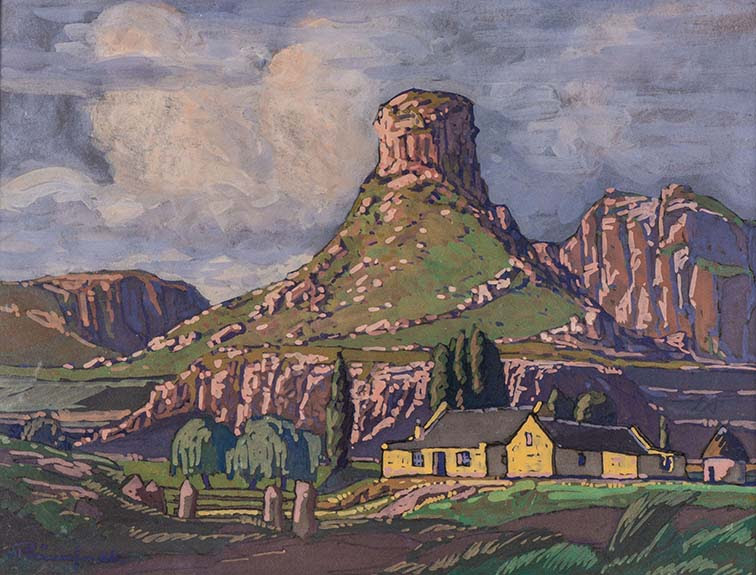
R 400 000 – 600 000
Landscape – Eastern Free State (Lot 506) shows that unlike Pierneef’s monumental, grand oil paintings, the artist’s casein works are often modestly scaled and less structured in their formal qualities. These casein works exhibit the artist’s ability to temper his style with impressionism and are widely regarded as his more lyrical and expressive works.
Casein is a milk-based binding agent and can be used in painting by grinding pigment in a solution of the substance. It has been used as a binder and adhesive for over 800 years, but the medium’s popularity dwindled with the advent of artificial polymers. Despite this long history, it hasn’t been a popular choice amongst artists due to its fast-drying rate, making it extremely difficult to handle. This paint demands a certainty and assuredness from the artist, as once dried, the medium sets like fine cement and becomes completely water resistant. For this reason, Pierneef has been regularly applauded for his successful use of this notoriously difficult paint. The medium may also speak to how prolific Pierneef was as an artist. Since it has a shelf life of only a few days, it would only be used by artists who are creating every day.
Casein has many of the desired qualities of oil, including its lustrous surface and completely opaque, vibrant colour. The medium also allows for the layering of impasto-like strokes, which can be built on once dried. Casein’s near indestructibility if painted onto surfaces with little pliability also means that many works are wonderfully preserved and show very little ageing.

