
The basics
Blood from our legs is returned to the heart via a system of veins. There are deep veins running within the leg muscles, and superficial veins that are under the skin.
Unlike arteries which transport blood from the heart to the rest of the body and have a thick muscle layer to regulate flow, the walls of veins are weaker with only a very thin muscle layer. When you are upright, the challenge is for the venous blood to flow effectively, against gravity. Veins have one-way valves to keep the blood moving in the right direction i.e. to the heart, and the leg muscles act like pumps when they contract e.g. while you walk.
Certain conditions can create a higher-than-normal back-pressure in the leg veins. Over time, the compromised venous flow and back-pressure lead to “chronic venous insufficiency” (CVI).
What are the symptoms of chronic venous insufficiency?
CVI may manifest as visible varicose veins.
Common symptoms of high venous pressure with poor circulation in the legs include
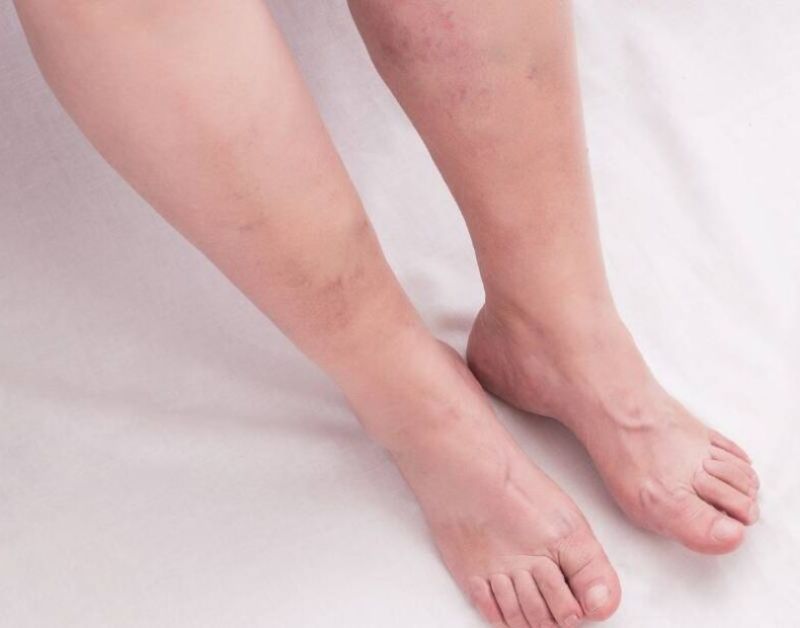
- Aching, throbbing, swollen and tired legs especially after standing for a while and at the end of the day.
- Skin changes such as itching, scaling and dark or reddish-brown discoloration, especially around the ankle.
- Small cuts which ooze and are slow to heal – and which can develop into problem open “venous ulcers”. These can take months or even years to close up.
What can you do to reduce symptoms?
For swelling:
- Try to be as active as possible – keep moving to improve circulation.
- Avoid standing or sitting in one position for too long and avoid sitting with crossed legs.
- When you are sitting, prop your legs up so your feet are higher than your thighs.
- Wear flat shoes and clothes which are loose around the legs and waist.
- Dropping excess weight will help to reduce the pressure in the leg veins.
For troublesome skin symptoms:
- Wash your legs with unscented aqueous cream or cleanser. Avoid ordinary soaps which can add to the dryness.
- Use the same aqueous cream on your legs just after you have dried them.
What are the treatments for chronic venous insufficiency?
Should you and your doctor decide that treatment is required, the options depend on the type of problem veins you have, and your symptoms. The aim of treatment is to relieve symptoms and to tackle the underlying cause of the problem, where possible.
What are the conditions which lead to chronic venous insufficiency?
Commonly, the condition is caused by faulty valves in the veins with resultant ineffective flow of blood from the legs back into the central circulation. Being prone to developing faulty valves increases with age, and can run in families or may be the result of damage following a blood clot in the leg, deep vein thrombosis or a leg injury.
Any condition which increases the pressure in the abdomen over a long period of time, making the upward flow of venous blood more difficult, can cause CVI. Examples include excess weight gain and pregnancy.
Leg compression
- Graduated elastic compression stockings may form part of your management. They fit tightly over the leg with the most pressure applied around the ankle, with less squeeze exerted the higher up they go. They help the leg muscles push the venous blood back to the heart. While one can buy some brands at the pharmacy, higher pressure compression stockings require a prescription.
- A common problem is that many people do not find them very comfortable or tolerable, especially in hot weather.
- While leg compression can relieve pressure symptoms like swelling and may prevent progression of skin symptoms, it does not remove the problem veins.
Medication
- In some instances, blood thinners may be appropriate to prevent clots and improve blood flow.
Surgical procedures
If the more superficial system of veins is involved, there are several surgical options that can be effective in the management of CVI by reducing venous backflow (reflux) and restoring better circulation.
- The preferred methods today are radiofrequency ablation or endovenous laser therapy. They are minimally invasive, catheter-based techniques where a catheter (tube) is used to track along the vein to deliver radiofrequency or laser energy, to damage and shrivel the vein closed. Sometimes a chemical sclerosant (a kind of superglue) is used to block the vein. These techniques work as well as the open surgical procedures and have the advantage of less pain and bruising and a faster recovery time.
- The most common open surgical procedures are:
- Vein stripping (Trendelenberg and strip)
- Phlebectomy (surgical removal of smaller veins)
Unfortunately, no treatment can prevent new varicose veins from forming. Also, if the problem veins are in the deep venous system, there is at this time no safe and effective surgical procedure which can help, and the focus of management is on symptom reduction.
At Cape Town Vascular, the vascular surgeons will discuss all the options and their advantages and disadvantages, to guide you to the best management choice for your vein problem.
This article was first published at https://topclickblogs.co.za/chronic-venous-insufficiency/
.
Video: Chronic Venous Insufficiency
More Info on Chronic Venous Insufficiency here: https://topclickblogs.co.za/chronic-venous-insufficiency/
Twitter: https://twitter.com/topclickmediasa
Facebook: https://www.facebook.com/topclickmediaSA/
CLICK HERE to submit your press release to MyPR.co.za.
Press Release Views since 1 July 2022: 65



 Cape Town Lens: Dead Duck