
A Cape Town Castle Military Museum tagged image from photographer – ell brown as published on Flickr.
Colchester Castle in Castle Park, Colchester – Italian and British flags
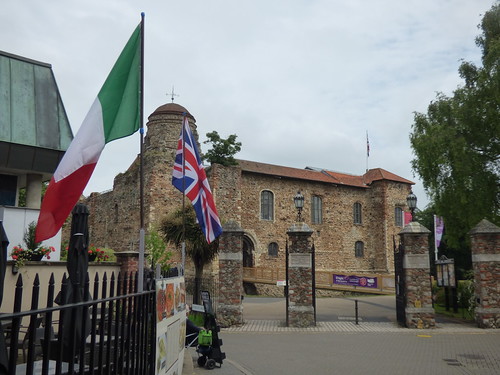
Image by ell brown
Headed into the Castle Park in
Colchester to see Colchester Castle. Did briefly go over the footbridge to look in the entrance, but we decided not to go in and go to the Hollytrees Museum nearby instead (which was free).
Colchester Castle in Colchester, Essex, England, is an example of a largely complete Norman castle. It is a Grade I listed building.
The attribution of the castle as a royal foundation is based on a charter of Henry I dated 1101, granting the town and castle of Colchester to Eudo Dapifer "as my father had them and my brother and myself", Henry’s father and brother being William I, "William the Conqueror", and William II, "William Rufus". The somewhat unreliable Colchester Chronicle, written in the late 13th century, credits Eudo with the construction of the castle and gives a commencement date of 1076. The design of the castle has been associated with Gundulf of Rochester purely on the basis of the similarities between Colchester and the White Tower at the Tower of London; however, both keeps also resemble the much earlier example at Château d’Ivry-la-Bataille in Upper Normandy.
Grade I Listed Building
The Castle Keep (Including Excavated Remains of Forebuilding in Moat)
Listing Text
1. CASTLE PARK
995 ———–
The Castle Keep
(including excavated remains
of forebuilding in moat)
TL 9925 SE 5/3 24.2.50.
I
2.
Built late C11 on the site of the great Roman Claudian Temple (the
foundations still exist under the castle), almost entirely of Roman tiles
and septaria. It was probably built in circa 1080 for William the Conqueror
as an important defensive work. It was much larger and more massive than
any other Norman Castle built in England – possibly partly because it had
to enclose the great Roman foundations still existing on the site.
It had 3 storeys or more and is now probably less than half its original
height, though still a most imposing structure and a most important
example of mediaeval military architecture. Demolition was begun in
1693, the height being reduced. Considerable restoration took place
in the mid C18 for Charles Grey. The dome over the great staircase was
added by James Deane in 1760. AM.
Listing NGR: TL9986425325
This text is from the original listing, and may not necessarily reflect the current setting of the building.
Description
1. CASTLE PARK
995 ———–
The Castle Keep
(including excavated remains
of forebuilding in moat)
TL 9925 SE 5/3 24.2.50.
I
2.
Built late C11 on the site of the great Roman Claudian Temple (the
foundations still exist under the castle), almost entirely of Roman tiles
and septaria. It was probably built in circa 1080 for William the Conqueror
as an important defensive work. It was much larger and more massive than
any other Norman Castle built in England – possibly partly because it had
to enclose the great Roman foundations still existing on the site.
It had 3 storeys or more and is now probably less than half its original
height, though still a most imposing structure and a most important
example of mediaeval military architecture. Demolition was begun in
1693, the height being reduced. Considerable restoration took place
in the mid C18 for Charles Grey. The dome over the great staircase was
added by James Deane in 1760. AM.
Listing NGR: TL9986425325
Italian and British flags seen near the park entrance at Ryegate Road and Castle Bailey coming up from Museum Street.
Click here to submit your Cape Town News – free.
Have you tried: Whale and Dolphin Watching in Algoa Bay?
Quick Cape Town Fact: The city has several notable cultural attractions. The Victoria & Alfred Waterfront, built on top of part of the docks of the Port of Cape Town, is the city’s most visited tourist attraction. It is also one of the city’s most popular shopping venues, with several hundred shops and the Two Oceans Aquarium.


 34 Free State students complete studies in China